
Grease trap cleaning for restaurants in Dubai is one of those maintenance jobs that’s easy to postpone — until a blocked line floods the kitchen floor mid-service. Every restaurant that cooks with oil produces fats, oils, and grease (FOG), and Dubai Municipality requires every commercial kitchen to trap and remove that FOG on a documented schedule.
Skip grease trap cleaning for restaurants in Dubai, and you’re not just risking a bad smell — you’re risking fines, a shutdown notice, and an expensive plumbing repair bill. This guide covers why it belongs on your permanent maintenance calendar, what Dubai Municipality actually requires, and how to know when it’s time to call a professional team.
A grease trap — also called a grease interceptor — sits between your kitchen sinks and the main sewer line. It slows down wastewater so fats, oils, and grease can rise and separate before the water continues into the drainage system.
Without one, FOG travels straight into the pipework, cools, and hardens into thick deposits that narrow pipe diameter over just a few weeks. This is exactly why grease trap cleaning for restaurants in Dubai is treated as infrastructure protection, not housekeeping — a single neglected trap can affect the whole building’s drainage line, not just one kitchen.
For any restaurant, café, cloud kitchen, or hotel kitchen operating in the UAE, a properly sized and well-maintained grease trap is the first line of defense against blockages, odors, and pest problems.
Dubai Municipality treats grease trap cleaning for restaurants in Dubai as a licensing requirement, not a suggestion. Commercial kitchens must install an approved trap, keep it in working order, and produce cleaning records on demand during inspections.
The full technical methodology — sizing, disposal, and documentation standards — is published in the Dubai Municipality Grease Trap Guideline. For a broader international reference on why FOG regulation exists in the first place, the US EPA’s guidance on fats, oils, and grease explains the sewer-system science behind these rules.
Operators who fail an inspection because of a neglected trap can face:
Keeping a paper trail of every cleaning — dates, technician details, and disposal method — is exactly what an inspector asks for, which is why working with a licensed provider that issues after-service reports matters as much as the cleaning itself.
There’s no single answer — frequency depends on kitchen size, menu, and how much FOG your restaurant generates daily. As a general guide for grease trap cleaning for restaurants in Dubai:
A widely used industry benchmark is the “25% rule” — once FOG and solids occupy roughly a quarter of the trap’s capacity, it’s time for cleaning, regardless of the calendar date. A quick inspection from your maintenance provider will confirm where your kitchen actually falls instead of guessing.
Don’t wait for a scheduled visit if you notice any of these warning signs:
Any one of these points to a trap that’s already past capacity — and a blocked line during service is one of the most disruptive things that can happen to a busy Dubai restaurant kitchen.
Neglecting grease trap cleaning for restaurants in Dubai compounds into several expensive problems:
A single missed cleaning cycle rarely causes a full shutdown, but a pattern of neglect almost always does — and the repair bill is usually far higher than routine maintenance would have cost.
On the flip side, a consistent schedule for grease trap cleaning for restaurants in Dubai pays for itself:
Grease trap cleaning works best as part of a wider hygiene routine. We’ve covered the fire-safety side of grease buildup in how often commercial kitchen hoods should be cleaned, and the bigger picture of asset upkeep in why regular maintenance is key to a long-lasting property. If you want the compliance angle explained in more depth, our earlier post on why regular grease trap cleaning is crucial for every kitchen in Dubai goes further into the municipality’s inspection process.
Pairing grease trap cleaning with related services — like kitchen hood cleaning and sump pit tank cleaning — closes most of the gaps that lead to health and safety violations in commercial kitchens.
Some smaller outlets try to manage grease trap cleaning in-house, and while it’s technically possible for very low-volume kitchens, it comes with trade-offs:
DIY cleaning can work for very small kitchens with minimal FOG output, but it still has to meet municipality disposal rules, and without documentation, it often fails to satisfy inspectors.
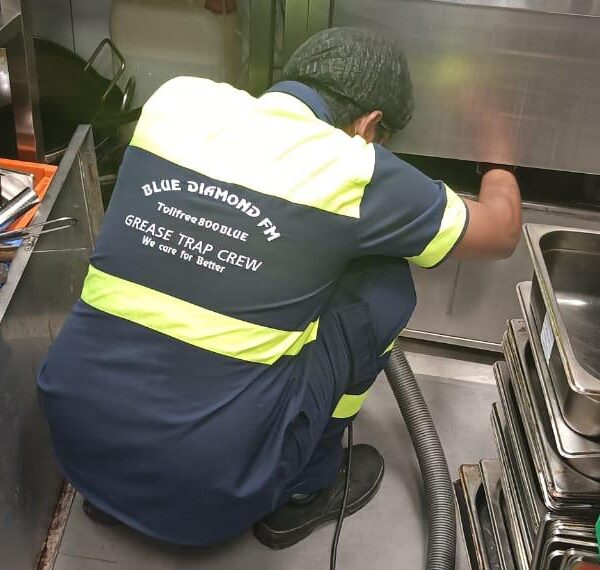
Professional grease trap cleaning for restaurants in Dubai brings vacuum tankers, jetting equipment, and eco-friendly disposal methods that meet Dubai Municipality standards, plus a signed service report that doubles as inspection-ready proof of compliance. Restaurant-industry publication QSR Magazine has covered similar grease-management standards in commercial kitchens abroad, and the underlying logic — documented, professional maintenance beats ad-hoc DIY — holds just as true in the UAE.
For most restaurants, the time saved and compliance certainty make professional cleaning the more practical choice, especially during busy seasons when kitchen downtime is costly.
Blue Diamond General Maintenance has spent years supporting restaurants, hotels, and cloud kitchens across the UAE with dependable, compliant grease trap cleaning services in Dubai. Our team offers:
If odor or hygiene concerns extend beyond the trap itself, our disinfection and sterilization services and AC duct cleaning can round out a full kitchen hygiene program.
Grease trap cleaning for restaurants in Dubai isn’t a task to schedule “when there’s time” — it’s a recurring compliance requirement that protects your kitchen, your license, and your reputation with diners. Building it into a routine maintenance calendar, alongside services like kitchen hood cleaning, is the simplest way to avoid an expensive surprise.
Ready to put your grease trap on a reliable schedule? Contact Blue Diamond for a free assessment and a cleaning plan built around your kitchen’s actual output. You can also browse more maintenance guides on our Blogs and News page.
Get in touch with us